

What are the most effective signs to remind employees to wash their hands?
 If you manage a team, you already know how quickly illness spreads in shared spaces. The simplest and most proven way to slow it down is also the most overlooked: proper hand hygiene. Displaying the right wash hands sign in the right place can change daily behaviour without a single conversation. In this guide, we cover what makes hand washing signs effective, which types work best for different workplaces, and exactly where to put them so they actually get noticed.
Why Are Hand Washing Signs Important in the Workplace?
Most workplace hygiene training happens once and then fades. A well-designed workplace hygiene sign works every single day without any additional effort from management. Research in behavioural science shows that visual prompts placed at the point of action, right next to a sink or at a door, are significantly more effective than general reminders or staff briefings. This is why hygiene signs are considered a frontline tool in infection control, not just a box-ticking exercise for audits.
For businesses in food service, healthcare, hospitality, and manufacturing, displaying employee hand washing signs is also a legal requirement under health and safety regulations. But beyond compliance, the right signage builds a workplace culture where hygiene is expected and normalised.
What Makes a Good Hand Washing Sign?
Not all hand wash reminder signs deliver the same results. Before you buy, it is worth understanding what actually makes a sign work. These are the qualities that consistently drive behaviour change:
a) Clear, direct language: Short commands like “Wash Your Hands” or “Clean Hands Save Lives” register faster and are harder to ignore than paragraphs of instruction.
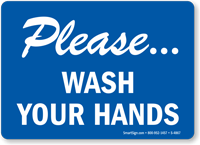
b) High contrast design: Dark text on a light background reads instantly. Decorative fonts slow reading and reduce impact, especially under poor lighting.
c) Step-by-step diagrams: For food prep and healthcare settings, visual technique guides reduce error and align staff with WHO-recommended handwashing steps.
d) Waterproof materials: Any waterproof hand washing sign made from vinyl or laminated board will outlast paper versions by years in high-moisture environments.
e) The right size: A sign too small to read from 2 to 3 feet away will be ignored. A4 or larger is standard for wall-mounted bathroom and kitchen signs.
How to Remind Employees to Wash Their Hands: The Best Sign Types
Choosing the right type of employee safety sign depends on your industry, your team size, and your compliance requirements. Here are the five types that consistently deliver the best results:
1. Mandatory Compliance Signs:- These carry direct, legally recognised wording such as “Employees Must Wash Hands Before Returning to Work.” They are the standard for food service, hospitality, and healthcare settings where hand hygiene is regulated. Browse our range of mandatory hand washing signs that meet workplace compliance requirements.
2. Step-by-Step Technique Posters:- These are among the best hand washing signs for food service and clinical environments. They guide employees through the full 6-step WHO handwashing technique with clear numbered illustrations, reducing errors and improving the quality of hand hygiene, not just the frequency. Shop our step-by-step handwashing posters for kitchens, labs, and care facilities.
3. Motivational Awareness Signs:- Sometimes the most effective hand washing reminder is one that appeals to a sense of team responsibility rather than obligation. Messages like “Clean Hands Protect Your Team” or “Germs Stop Here” work particularly well in offices, retail settings, and warehouses where mandatory language can feel out of place. See our hygiene awareness posters for a softer, engagement-focused approach.
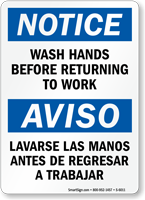
4. Bilingual and Multilingual Signs:- A bilingual wash your hands sign ensures the message reaches every member of your team regardless of their primary language. This is a practical necessity in diverse workplaces such as warehouses, manufacturing facilities, and large restaurant kitchens. Our bilingual hand washing signs are available in a wide range of language combinations to suit your workforce.
5. Waterproof and Wet-Area Signs:- For industrial kitchens, outdoor food stalls, and any high-moisture environment, standard signs will not last. A waterproof hygiene sign made from self-adhesive vinyl or rigid laminated board maintains clarity and adhesion even under daily cleaning and steam exposure. These are the hand washing signs for the workplace that facilities managers and food safety officers trust for long-term use.
Where to Put Hand Washing Signs in the Workplace
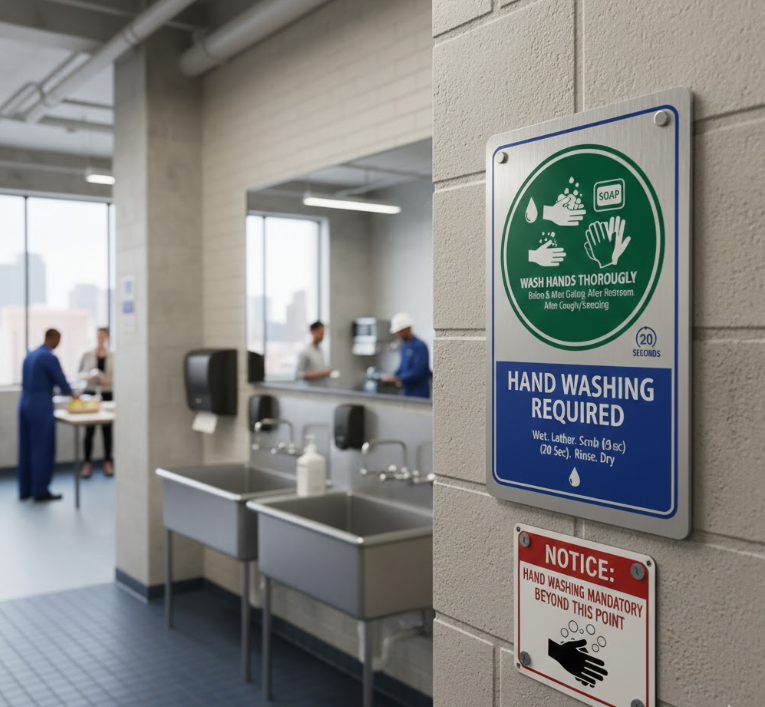
Even the best workplace hygiene sign will not work if it is in the wrong spot. Placement determines whether the sign is seen at the exact moment the behaviour should happen. Position your hand washing signs in these key locations:
i) Directly above or beside the sink at eye level, this is the highest-impact position for any wash hands sign
ii) On the inside of toilet cubicle doors in staff bathrooms, where employees have time to read before approaching the sink
iii) At entry and exit points to kitchens and food preparation areas, reinforcing the habit before and after contact with food
iv) Next to hand sanitiser dispensers in communal spaces and reception areas
v) At break room entry points in warehouses and manufacturing sites, where staff transition from production areas to shared spaces
The right hand washing sign for the workplace is a small investment with a significant return: fewer sick days, better compliance, and a stronger hygiene culture across your entire team. Whether you need printable employee hygiene reminder signs, rigid wall-mounted boards, or custom branded options, our full range covers every workplace type and budget.
Frequently Asked Questions
1. Are hand washing signs a legal requirement in the workplace?
A: Yes, in many industries. Food service, healthcare, and childcare facilities are typically required by law to display hand washing signs. Check your local health and safety regulations to confirm the specific requirements for your sector.
2. What is the best material for a wash hands sign near a sink?
A: Waterproof vinyl or laminated polypropylene. Both hold up against moisture and cleaning products for years. Avoid paper or card near sinks as they deteriorate quickly and look unprofessional.
3. How often should workplace hygiene signs be replaced?
A: Replace signs when they become faded, damaged, or hard to read. Quality waterproof signs typically last 3 to 5 years. Build sign checks into your regular safety audits to stay on top of replacements.
4. Why do hand washing reminders work better as signs than verbal instructions?
A: Signs appear at the exact moment and location where the behaviour should happen. Verbal instructions fade from memory quickly. A well-placed sign provides a consistent, silent nudge every time an employee approaches a sink, with no management input required.
Category: Restrooms