
What Are Restroom Signs? Regulations and Best Practices
Restroom signs are visual markers that identify bathroom facilities and communicate accessibility, gender designation, and directional information to building occupants. Under federal law, these signs qualify as permanent room identification, which means they’re subject to specific ADA requirements for tactile characters, Braille, contrast, and mounting location.
This guide covers the main types of restroom signs, federal ADA and California Title 24 compliance requirements, proper installation guidelines, and how to select the right materials for your facility.
What are restroom signs
Restroom signs are visual markers that identify bathroom facilities and communicate key information like gender designation, accessibility features, and directions. You’ve seen them countless times: the familiar silhouette figures on doors, the wheelchair symbol indicating an accessible facility, or arrows pointing the way down a hallway. What you might not realize is that these signs aren’t just helpful; they’re legally required to meet specific design standards under federal accessibility law.
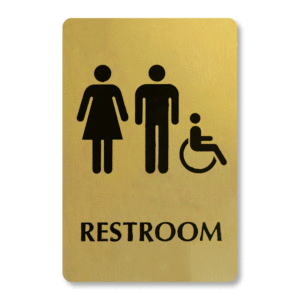
The Americans with Disabilities Act (ADA) classifies restroom signs as permanent room identification signs, which means they fall under strict requirements for tactile characters, Braille, contrast, and mounting location. In California, Title 24 of the state building code adds even more specifications. So while a restroom sign might seem straightforward, getting it right involves understanding a fair amount of regulatory detail.
Beyond compliance, restroom signs serve a practical wayfinding function. In large facilities like hospitals, airports, or office complexes, clear signage helps visitors navigate independently. And for people who are blind or have low vision, properly designed tactile signs provide critical information through touch.
Types of restroom signs
Not all restroom signs serve the same purpose. Some identify the facility itself, while others provide directions or indicate special features. Here’s a breakdown of the main categories you’ll encounter.
1. Accessible restroom signs
Accessible restroom signs display the International Symbol of Accessibility, the wheelchair icon recognized around the world. This symbol indicates that the restroom includes features like grab bars, adequate turning space for wheelchairs, and accessible fixtures. Any restroom designated as accessible requires this symbol under federal law.
2. Men’s and women’s restroom signs
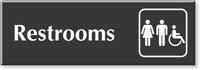
Traditional gender-designated signs are still the most common type in commercial buildings. They typically feature pictograms (the familiar silhouette figures) along with the words “Men” or “Women.” When these signs are ADA-compliant, they also include raised tactile characters and Grade 2 Braille positioned below the text.
3. Unisex and all-gender restroom signs
Gender-neutral restroom signage has become increasingly common in recent years. These signs might display a combined pictogram, a toilet icon, or simply the word “Restroom.” Some jurisdictions now require at least one all-gender option in certain building types, though requirements vary significantly by location.
4. Directional restroom signs with arrows
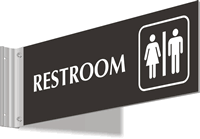
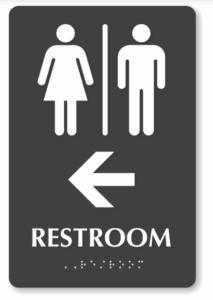
Wayfinding signs guide people through a building toward restroom locations. They feature arrows pointing left, right, up (meaning straight ahead), or down (indicating behind or below the current location). Placing directional signs at decision points, like hallway intersections or building entrances, helps visitors find facilities without wandering.
 5. Family and companion care restroom signs
Family restrooms accommodate parents with young children, while companion care restrooms serve individuals who require assistance from a caregiver of a different gender. These signs typically include appropriate pictograms and often display the accessibility symbol when the facility meets those standards.
ADA requirements for restroom signs
The ADA establishes federal standards for accessible signage, and restroom signs fall squarely under these rules. Compliance isn’t optional for public accommodations and commercial facilities. It’s a legal requirement. Here’s what the law specifies.
– Tactile characters and Braille standards
Tactile characters are raised letters that people can read by touch. The ADA requires them on all permanent room identification signs, including restrooms. The specifications are precise:
- Character height: Between 5/8 inch and 2 inches tall
- Raised height: Letters raised at least 1/32 inch from the sign surface
- Letter case: All uppercase for tactile text
- Braille: Grade 2 Braille positioned directly below the corresponding text
Grade 2 Braille, by the way, is the standard form of Braille that uses contractions and abbreviations rather than spelling out every letter individually.
– Pictogram and symbol requirements
When you use pictograms like the male and female silhouettes, the ADA requires a pictogram field at least 6 inches high. Here’s an important detail: the pictogram itself cannot be raised or tactile. Only the text below the pictogram field includes tactile characters and Braille. The International Symbol of Accessibility follows its own placement guidelines when required.
– Color contrast and non-glare finish
ADA-compliant signs require sufficient contrast between characters and background, though the regulations don’t specify exact color combinations. Light text on a dark background works, and so does dark text on a light background. The sign surface also requires a non-glare finish. Glossy signs can be difficult to read under certain lighting conditions.
– Sign size and character proportion
The ADA specifies that character stroke width (the thickness of the letters) falls between 10% and 30% of character height. This proportion ensures letters aren’t too thin to feel or too thick to distinguish by touch. While there’s no mandated overall sign size, the character specifications effectively determine minimum dimensions.
– California Title 24 restroom sign requirements
If your facility is in California, you’re dealing with two sets of rules. California Building Code Title 24 includes accessibility requirements that go beyond federal ADA standards in several ways. Since you have to meet both, you’re effectively following the stricter Title 24 specifications.
– Geometric symbol standards
California requires something the federal ADA doesn’t: geometric symbols on restroom signs. Men’s restrooms require a raised circle (1/4 inch), while women’s restrooms require a raised triangle (1/4 inch). These tactile shapes give people with visual impairments an additional way to identify the facility.
– Raised character and Braille specifications
Title 24 specifies that raised characters use sans serif fonts with stroke widths between 10% and 30% of character height, similar to ADA requirements. However, California has additional specifications for Braille dot spacing and placement that differ slightly from federal standards.
Differences between Title 24 and federal ADA
| Requirement | Federal ADA | California Title 24 |
| Geometric symbols | Not required | Required (circle for men, triangle for women) |
| Character case | Uppercase required | Uppercase required |
| Braille | Grade 2 required | Grade 2 with specific spacing requirements |
| Mounting height | 48″ to 60″ to baseline | 48″ to 60″ to baseline |
The geometric symbol requirement is the most visible difference. If you’re ordering signs for a California facility, make sure they include the appropriate circle or triangle.
Restroom sign mounting and placement guidelines
A perfectly designed sign fails to meet ADA requirements if it’s installed in the wrong location. Proper placement ensures people with visual impairments can locate and read signs consistently, regardless of which building they’re in.
i) Required mounting heights
The baseline of tactile characters (the bottom of the letters) belongs between 48 inches and 60 inches above the finished floor. This height range allows people of various heights, including wheelchair users, to reach the sign and read tactile elements comfortably.
ii) Latch side installation rules
Signs identifying permanent rooms like restrooms go on the wall adjacent to the latch side of the door. That’s the side with the door handle, not the hinges. Position the sign so its centerline falls at least 18 inches from the door frame. This placement allows someone to stand close enough to read tactile characters without blocking the door swing.
iii) Protruding object restrictions
Signs mounted on walls cannot stick out more than 4 inches into circulation paths if their leading edge is between 27 inches and 80 inches above the floor. This rule prevents signs from becoming hazards for people using canes to detect obstacles. Most restroom signs mount flat against the wall, so this typically isn’t an issue.
Restroom sign materials
The material you choose affects how long your sign lasts, how it looks, and whether it’s appropriate for your environment. Each option has distinct advantages.
a) Acrylic signs
Acrylic provides a polished, professional appearance that works well in corporate offices, healthcare facilities, and retail environments. It accepts tactile characters and Braille easily and resists fading over time. Acrylic performs best indoors in climate-controlled settings.
b) Aluminum signs
Aluminum offers excellent durability for high-traffic areas and outdoor applications. It resists rust and corrosion, making it a good choice for industrial facilities, parking structures, and exterior locations where weather is a factor.
c) Plastic signs
Plastic signs provide a cost-effective option for basic compliance. They’re lightweight, easy to install, and available in many colors and styles. While less premium-looking than acrylic, quality plastic signs meet all ADA requirements.
d) Photoluminescent signs
Photoluminescent materials absorb ambient light and glow in darkness. During power outages, these signs remain visible and help building occupants locate facilities. They’re particularly useful in facilities where emergency preparedness is a priority.
How to choose restroom signs for your facility
Selecting compliant restroom signage involves more than picking an attractive design. A systematic approach helps ensure you meet all applicable requirements while creating a cohesive look throughout your building.
– Identify applicable regulations
Start by determining which standards apply. All public accommodations and commercial facilities fall under federal ADA requirements. California facilities also comply with Title 24. Some cities have additional local ordinances, particularly regarding all-gender restroom signage, so checking local codes is worthwhile.
– Match signs to your environment
Consider the conditions your signs will face:
- Traffic level: High-traffic areas benefit from durable materials like aluminum
- Indoor vs. outdoor: Exterior signs require weather-resistant materials and finishes
- Cleaning protocols: Healthcare and food service facilities may want signs that withstand frequent sanitization
- Aesthetic requirements: Signs can complement your facility’s design while maintaining compliance
– Plan for wayfinding and visibility
Think beyond individual restroom doors to your facility’s complete wayfinding system. Directional signs placed at main entrances and hallway intersections guide visitors toward restroom locations. Using consistent design across all restroom signage (matching colors, fonts, and pictogram styles) creates a professional appearance and reduces confusion.
Tip: When ordering restroom signs, consider purchasing extras for future needs. Having matching replacement signs on hand saves time if signs become damaged or if you add new facilities later.
Simplify restroom sign compliance for your building
Getting restroom signage right protects your facility from accessibility complaints while ensuring all visitors can navigate independently. The key is matching sign types, materials, and placement to your specific environment and the regulations that apply.
MyDoorSign offers ADA-compliant and California Title 24 restroom signs organized by use case and regulation, making it straightforward to find what your facility requires.
Frequently asked questions about restroom signs
1. What is the ASL sign for restroom?
A. The American Sign Language sign for restroom involves forming the letter “R” with your hand (crossing your index and middle fingers) and shaking it slightly near your chin.
2. Are gender-neutral restroom signs legally required?
A. Requirements vary by jurisdiction and building type. Some states and cities mandate all-gender restroom options in certain facilities, while others leave the decision to building owners. Local codes provide the specific requirements for your area.
3. How often should restroom signs be replaced?
A. There’s no fixed replacement schedule. Signs typically get replaced when they become damaged, faded, or difficult to read, or when regulations change and existing signs no longer meet current standards.
4. Can custom restroom signs meet ADA compliance standards?
A. Yes. Custom signs can be fully ADA compliant when they incorporate all required elements: proper tactile characters, Grade 2 Braille, adequate contrast, non-glare finish, and correct mounting specifications.
Category: ADA