

What Every Business Should Know About Braille Signs
For millions of visually impaired Americans, navigating a public building can be a challenge. Simple tasks like finding the restroom, identifying a conference room, or locating the nearest exit rely heavily on clear, tactile communication. This is why the Americans with Disabilities Act (ADA) mandates specific signage standards for all public facilities.
Compliance is not just about avoiding costly federal fines. It is about inclusivity. When your facility is properly equipped with Braille and tactile signage, you ensure that every visitor, client,
and employee can navigate your space with independence and dignity.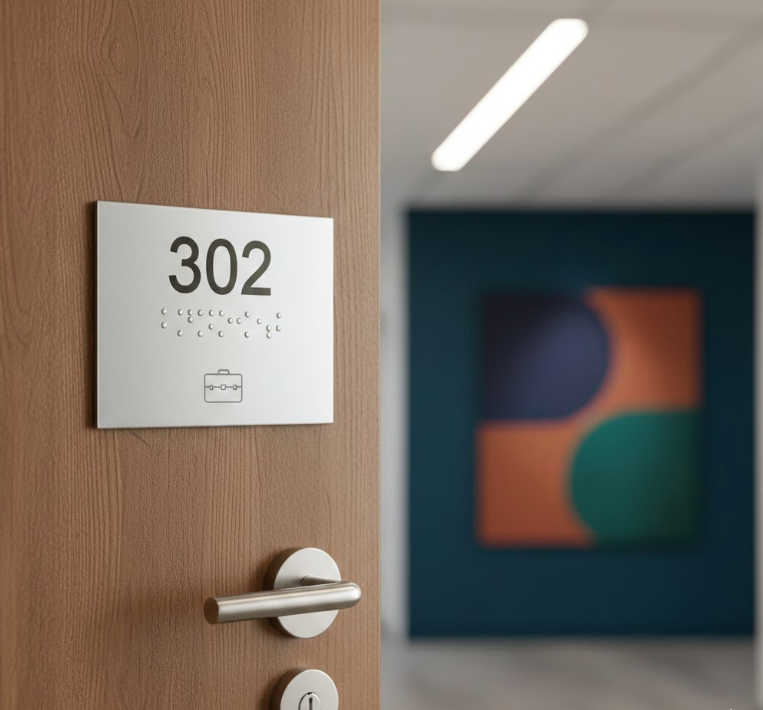
However, ADA regulations are precise and unforgiving. A sign mounted two inches too high or on the wrong side of the door can fail an inspection. Learn more about the critical requirements for Braille signage and how to install them correctly.
What Are ADA Braille Signs?
ADA Braille signs are high-contrast tactile markers designed to be read by touch and sight. They feature raised text (tactile characters) accompanied by Grade 2 Braille. These signs identify permanent rooms and spaces within a building. When outfitting your office or facility, you will primarily need:
Shop ADA Braille Signs:
-
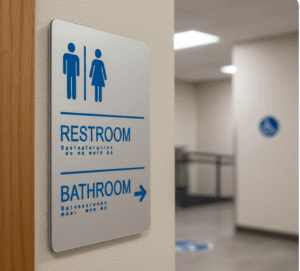
Restroom & Bathroom Signs
-
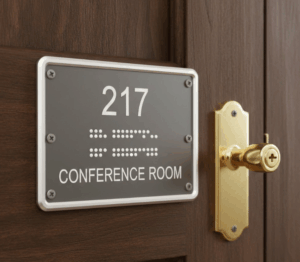
Room Number & Name Plates
-

Exit & Stairwell Signs
-
Accessible Entrance Markers
3 Critical Requirements for ADA Compliance
The ADA Standards for Accessible Design (2010) outline strict rules for how these signs must look and where they must go. Here are the three most important factors.
1. Identification of Permanent Rooms
Not every sign needs Braille. Temporary signs, such as a paper “Out of Order” note or a tenant name in a changeable slot, are exempt. The Rule: You must install Braille signs for any room or space that is permanent. This includes restrooms, electrical rooms, vending areas, kitchenettes, and numbered offices. If the room changes function (e.g., “Conference Room A” becomes “Storage”), the sign must be updated.
2. Specific Mounting Location
You cannot simply stick the sign on the door itself. If the door swings open, the sign disappears or becomes dangerous to a blind person trying to read it. The Rule: Signs must be installed on the latch side of the door. If there is not enough wall space on the latch side, the sign should be placed on the nearest adjacent wall. The only exception is for doors that swing inward and have automatic closers, where the sign may be placed on the door itself.
3. Height Requirements
Standardizing height ensures that a visually impaired person knows exactly where to reach to find information. The Rule: The tactile characters (the raised text) must be located between 48 inches and 60 inches above the finished floor. This range ensures the sign is accessible to people standing and people using wheelchairs.
Tips for Selecting Compliant Signs
-
Check the Contrast: The background and the text must have a high level of contrast (e.g., white text on a black background). A silver sign with gray text is essentially invisible to someone with low vision.
-
Use Grade 2 Braille: The ADA requires “Grade 2” Braille, which uses contractions and abbreviations rather than spelling out every single letter. This saves space and is the standard for literacy.
-
Avoid Serif Fonts: The visual text must be in a sans-serif font (like Helvetica or Arial) and totally uppercase. Fancy, decorative scripts are prohibited because they are difficult to read.
Incorporate the Right Signs Into Your Facility
Installing ADA signs is one of the most visible ways to demonstrate your commitment to accessibility. By following these standards, you protect your business from litigation and creating a welcoming environment for all members of your community.
Read through some of the other articles published on our blog to get more expert advice on facility compliance and legal standards.
Frequently Asked Questions (FAQ)
1. Which rooms require ADA Braille signs?
A. All permanent rooms and spaces require them. This includes restrooms, closets, mechanical rooms, cafeterias, and designated offices (e.g., “Room 204”). Temporary signs, building directories, and menus are generally exempt from the tactile Braille requirement.
2. What is the correct height for an ADA sign?
A. Between 48 and 60 inches from the floor. Specifically, the baseline of the lowest raised character must be at least 48 inches high, and the baseline of the highest raised character must be no more than 60 inches high. This ensures the sign is reachable for both standing individuals and wheelchair users.
3. What side of the door does the Braille sign go on?
A. The sign goes on the latch side of the door. It should be mounted on the wall next to the door handle. This prevents the reader from being hit if the door suddenly opens. If double doors are used, the sign should be placed to the right of the right-handed door.
4. What is Grade 2 Braille?
A. Grade 2 Braille is a shorthand version of Braille. Unlike Grade 1, which represents each letter individually, Grade 2 uses special contractions for common words (like “the,” “and,” “for”) to make reading faster and signs more compact. The ADA specifically mandates the use of Grade 2 Braille for all compliance signage.
Category: ADA